

SKF Bearing Load Rating per EN ISO 281 Wholesale Supplier for EU Buyers
Most EU buyers assume a higher basic dynamic load rating C means longer bearing life. That assumption fails the moment your application deviates from standard test conditions.
The ISO 281 standard defines the basic dynamic load rating C as the constant radial load a bearing can endure for a rating life of one million revolutions with 90% reliability. But real-world life depends on applying the modified rating life formula Lnm = a1 × aSKF × (C/P)^p, where the SKF life modification factor aSKF accounts for lubrication conditions, contamination levels, and fatigue load limits — factors that matter far more than the raw C value printed in a catalog. [NEED_CITE: ISO 281:2007 defines basic dynamic load rating and modified rating life calculation method]
I remember a paper mill in northern Vietnam where烘缸辊子 bearings kept seizing every few months. The maintenance team had selected replacements purely by matching the C value from the OEM catalog. What they missed was the ambient temperature hovering near 40°C year-round with relative humidity above 85%, conditions that accelerated lubricant degradation far beyond what the standard aSKF tables assumed. We recalculated using the modified life equation with adjusted contamination and lubrication factors, and the replacement interval extended substantially. That was the moment I stopped trusting catalog C values at face value and started working backward from actual operating conditions.

Understanding how SKF bearing load rating per EN ISO 281 wholesale supplier networks interpret these standards makes the difference between a bearing that lasts and one that becomes a recurring cost center.
How Does the ISO 281 Modified Life Formula Actually Work in Practice?
The original L10 life calculation assumes ideal lubrication, zero contamination, and no fatigue load limit — conditions that almost no industrial application meets. The ISO 281:2007 revision introduced the modified rating life concept through the aSKF factor, which compresses lubrication quality, contamination severity, and fatigue load into a single multiplier. [NEED_CITE: ISO 281:2007 introduced modified rating life with aSKF factor for real-world condition adjustment]
Here is how the calculation chain works step by step:
- Determine the basic dynamic load rating C from the bearing catalog — this is a fixed value based on material and geometry, defined as the load yielding one million revolutions at 90% reliability. [NEED_CITE: Basic dynamic load rating C definition per ISO 281]
- Calculate the equivalent dynamic bearing load P using the standard formula P = X·Fr + Y·Fa, where Fr is radial load and Fa is axial load, with X and Y factors depending on bearing type and load ratio.
- Compute the basic rating life L10 using L10 = (C/P)^p, where p equals 3 for ball bearings and 10/3 for roller bearings.
- Determine the SKF life modification factor aSKF by cross-referencing the fatigue load ratio (Pu/P, where Pu is the fatigue load limit) against the lubrication condition parameter κ (the ratio of actual lubricant film thickness to the theoretically required film thickness). [NEED_CITE: aSKF factor determination requires fatigue load limit Pu and lubrication condition κ per ISO 281]
- Apply the modified rating life Lnm = a1 × aSKF × L10, where a1 adjusts for required reliability beyond 90%.
A textile machinery manufacturer in Turkey once ordered a batch of deep groove ball bearings based solely on matching the C value of their previous supplier’s product. The bearings failed within months. When we reviewed the application, the spindle speed ran at a level where κ dropped below the threshold for adequate elastohydrodynamic lubrication, pushing aSKF down sharply. The raw C value was identical, but the modified life was a fraction of what the L10 calculation suggested.

When you source from a SKF bearing load rating per EN ISO 281 wholesale supplier, ask whether they provide application-specific aSKF calculations or just forward catalog data. The answer tells you whether you are getting engineering support or just a parts list.
What Happens When Static Load Gets Ignored in High-Temperature Environments?
The basic static load rating C0 matters most when bearings operate at very low speeds, execute slow oscillations, or sit idle under sustained load — and it becomes the governing criterion in high-temperature applications where dynamic load capacity degrades. ISO 76 defines C0 as the static load producing a contact stress at the most heavily loaded rolling element-raceway contact that causes a permanent deformation of approximately one ten-thousandth of the rolling element diameter. [NEED_CITE: ISO 76 defines basic static load rating C0 based on permanent deformation threshold]
In tropical climates across Southeast Asia, ambient temperatures regularly push bearing operating temperatures into ranges where standard grease degrades faster than catalog life predictions assume. I worked with a sugar processing facility in Indonesia where spherical roller bearings on conveyor drives kept showing early spalling. The maintenance team had sized everything by dynamic load C, but the combination of high ambient heat, sugar dust contamination, and frequent start-stop cycles meant the actual lubrication condition was far worse than the κ values used in their aSKF lookup.
We shifted the selection approach:
- First, we verified that the static load safety factor s0 = C0/P0 met the threshold for the specific load type — steady loads require lower s0 than shock loads. [NEED_CITE: Static load safety factor s0 requirements vary by load condition per ISO 76]
- Second, we selected bearings with higher C0 relative to C, accepting a slightly larger envelope to gain static capacity margin.
- Third, we specified high-temperature grease with a dropping point well above the expected operating temperature and re-lubrication intervals matched to the actual contamination ingress rate.
The failure rate dropped noticeably, and the maintenance team stopped treating bearing replacement as a routine scheduled task.

A SKF bearing load rating per EN ISO 281 wholesale supplier who only quotes C values without asking about temperature, speed, and contamination is selling you a number, not a solution.
How Do Cross-Brand Load Ratings Compare When Interchanging SKF, NSK, and FAG?
Basic dynamic load ratings C are calculated per ISO 281 across all major manufacturers, but the modified life factor aSKF is proprietary to SKF — meaning direct C-to-C comparison across brands misses the life adjustment that SKF’s methodology captures. [NEED_CITE: ISO 281 basic load rating calculation is standardized, but modified life factors differ by manufacturer]
When EU buyers request cross-reference substitution — say, replacing an SKF 22320 with an equivalent NSK or FAG part — the C values in the catalogs will be close but not identical, because the underlying geometry and material specifications differ slightly. The critical question is not whether C matches exactly, but whether the modified rating life under your specific operating conditions delivers equivalent performance.
| Parameter | SKF Catalog | NSK Catalog | FAG Catalog |
|---|---|---|---|
| Basic dynamic load rating C | Per ISO 281 | Per ISO 281 | Per ISO 281 |
| Basic static load rating C0 | Per ISO 76 | Per ISO 76 | Per ISO 76 |
| Modified life factor | aSKF (proprietary) | a23 (proprietary) | Xlife factor (proprietary) |
| Fatigue load limit Pu | Published | Published | Published |
| Contamination adjustment | Integrated in aSKF | Separate factor | Separate factor |
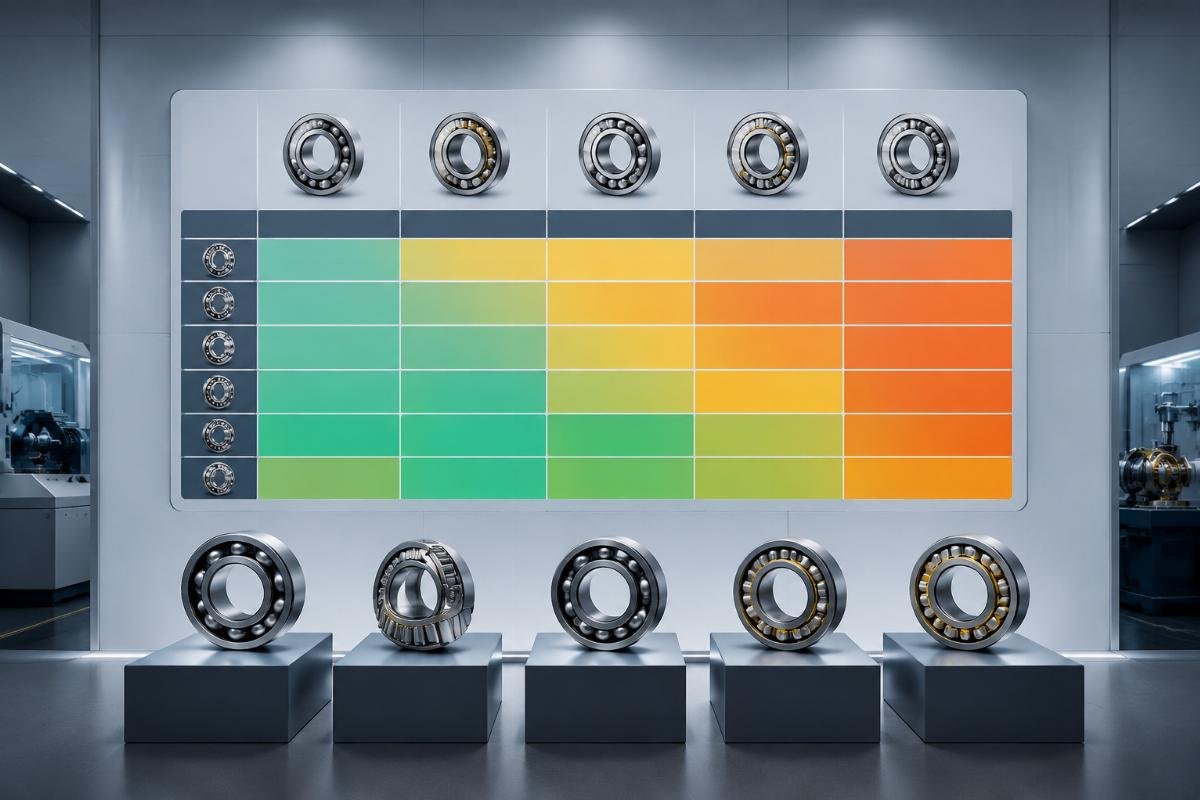
A European paper distributor needed to replace a large batch of spherical roller bearings originally specified as SKF 22320. Supply chain delays pushed them to consider NSK and FAG alternatives. We ran the modified life calculation for all three options using the actual operating parameters — temperature, speed, load type, and estimated contamination level. The SKF option showed the longest modified life due to the aSKF factor capturing contamination effects more comprehensively, but the NSK alternative came close enough that the cost difference justified the switch for non-critical positions. The FAG option, while dimensionally interchangeable, showed a noticeably shorter modified life under the same conditions because its proprietary adjustment factor handled contamination differently. [NEED_CITE: Manufacturer-specific modified life factors handle contamination and lubrication differently]
Working with a SKF bearing load rating per EN ISO 281 wholesale supplier who understands these proprietary differences prevents costly interchange mistakes that look right on paper but fail in the field.
What Verification Steps Protect EU Buyers from Counterfeit Bearings in Load-Critical Applications?
Counterfeit bearings rarely fail because their dimensions are wrong — they fail because their material quality and heat treatment cannot deliver the load ratings stamped on the label, and this gap only shows up under real operating stress. [NEED_CITE: Counterfeit bearing failure modes include material defects and improper heat treatment affecting load capacity]
EU buyers sourcing through wholesale channels face particular risk because the supply chain often involves multiple intermediaries, each adding a point where genuine product can be swapped. I have seen batches where the outer packaging looked correct, the bearing markings matched the catalog, and even the basic dimensional checks passed — but the raceway hardness fell well below the HRC 58-62 range expected for through-hardened bearing steel, meaning the actual fatigue load limit Pu was a fraction of what the catalog claimed.
Here is the verification sequence we follow for load-critical applications:
- Source confirmation — verify that the supplying entity traces back to an authorized distributor or a tier-one dealer with documented chain of custody. [NEED_CITE: Authorized distributor verification prevents counterfeit entry at source]
- Visual and marking inspection — check laser-etched markings for font consistency, country-of-origin stamps against the manufacturer’s current production facilities, and packaging quality against known genuine samples.
- Dimensional spot-check — measure bore, outside diameter, and width against ISO tolerance classes; counterfeits often fall outside P0/P6 tolerance bands even when markings claim compliance. [NEED_CITE: ISO tolerance class verification catches dimensional non-compliance in counterfeit bearings]
- Material hardness verification — sample testing of raceway and rolling element hardness; genuine through-hardened bearing steel should fall within the HRC 58-62 range.
- Rotation quality assessment — genuine bearings show smooth rotation with consistent starting and running torque; counterfeits often exhibit roughness or binding due to poor surface finish on raceways.
A maintenance manager at a Central Asian cement plant discovered that a batch of tapered roller bearings sourced through an online marketplace had raceway hardness readings well below specification. The bearings had been installed on kiln support rollers — a high-load, high-temperature application. Within weeks, multiple bearings showed early spalling. The cost of the unplanned downtime and replacement labor dwarfed the price difference between the counterfeit purchase and genuine product.

A reliable SKF bearing load rating per EN ISO 281 wholesale supplier provides transparent sourcing documentation and supports verification at every step, because their product quality does not depend on hiding the supply chain.
Conclusion
The ISO 281 basic dynamic load rating C is a starting point, not a destination — real bearing life depends on modified rating life calculations that account for your actual lubrication, contamination, and temperature conditions. Cross-brand interchange requires understanding proprietary life modification factors, not just matching C values. And in load-critical applications, authenticity verification protects against material defects that no catalog number can reveal. Select your SKF bearing load rating per EN ISO 281 wholesale supplier based on their ability to provide application-specific engineering support, not just catalog forwarding.




Leave a Reply